Showing posts with label Women's Cricket Super League. Show all posts

Thursday, 14 April 2016

Kia Super League Teams taking shape

With the announcement today of the three international players who have signed for each of the six Kia Super League teams, the shape and strength of the teams is beginning to emerge. This follows on from the announcement last week of the England players allocated to each team.

Big names are Ellyse Perry to Loughborough Lightning, as suspected; Meg Lanning to Surrey Stars; Suzie Bates to Southern Vipers; and WWT20 winning captain Stafanie Taylor to the Western Storm.

The final piece in the jigsaw is due next week when the two or three Academy players per team will be announced, together with the additional players that each franchise has selected to boost their roster to the full 15. We will wait to comment on the strengths of each squad until the full 15 players have been named, but in the meantime here is how the teams are currently shaping up :-

Lancashire Thunder

Kate Cross, Sarah Taylor, Danni Wyatt
Sarah Coyte, Deandra Dottin, third tba


Loughborough Lightning
Georgia Elwiss, Rebecca Grundy, Amy Jones, Beth Langston
Sophie Devine, Dane van Niekerk, Ellyse Perry


Southern Vipers
Charlotte Edwards, Tash Farrant, Lydia Greenway
Suzie Bates, Sara McGlashan, Megan Schutt


Surrey Stars
Tammy Beaumont, Laura Marsh, Nat Sciver
Rene Farrell, Marizanne Kapp, Meg Lanning


Western Storm
Heather Knight, Anya Shrubsole, Fran Wilson
Lizelle Lee, Rachel Priest, Stafanie Taylor


Yorkshire Diamonds
Katherine Brunt, Jenny Gunn, Dani Hazell, Lauren Winfield
Alex Blackwell, Shabnim Ismail, Beth Mooney


MD
14/IV/16

Monday, 25 January 2016

WBBL Shakedown

The ticker-tape has been cleared up and the MCG has fallen silent after the final of the inaugural WBBL reached an exciting, if rather unprofessional, conclusion on Sunday. It was the Thunder that returned to Sydney with the trophy, probably sharing a plane with their dejected Sixer opponents.

To be honest the final was not a great cricketing spectacle, but then finals often aren't! The Thunder contrived to drop simple catches, and fail to run out opponents who were at one time both on the ground in the middle of the wicket. The Sixers were equally as generous and misfields accounted for three of the Thunder's 10 boundaries. Without them it would have been a much tighter contest. It was therefore probably appropriate that the game finished with a leg-side wide, on which the batsmen ran a single, only to be gifted an overthrow by, of all people, Ellyse Perry, as she fired at the stumps at the bowler's end from two yards away and missed.

But ultimately the rather amateur-standard of the final actually reflects the true current state of women's cricket. There are very few full-time professionals currently in the women's game. Of those who played on Sunday I would suggest that only four players actually fall into that category - Perry, Alyssa Healy, Alex Blackwell and Stafanie Taylor, with perhaps Erin Osborne as another. The rest are effectively amateurs or semi-pros at best.

The fact that the Aussie public seem to have taken the WBBL to their hearts and made it such a huge success would suggest that they can look beyond the odd fumble and dropped catch, and that they are enjoying seeing the girls perform on the big stage. There is a massive wave of support behind women's sport at the moment and the WBBL is surfing that wave. The trick now is to make sure that there are more waves to be caught.

No doubt the top dogs at Cricket Australia are currently in a room somewhere licking their nether regions contentedly. And indeed they have every right to do so. They have invested heavily and wisely in women's cricket. Not only are there decent contracts in place for the Southern Stars (and a willingness to change who those contracted players are), but they have invested in the domestic players playing in the WNCL with all players receiving Au$7,000, and a further Au$3,000 - Au$10,000 if they play in the WBBL. But, perhaps even more significantly, CA shared the cost of getting the WBBL onto free-to-air television. No-one had any great expectations for the viewing figures, but they have been huge, which meant production company Ten decided to switch coverage to their more popular channel and cover more games. The result has been an explosion of interest in women's cricket in Australia and talk of a standalone television deal for WBBL2.

In contrast the ECB, who have also invested heavily, have provided contracts for 19 players, but nothing for those below them. The Women's Cricket Super League this summer will see no salaries for the participants. Instead the ECB will provide franchises with money to cover small match fees and expenses for the players (including those already on England contracts), and the competition is incentivized by prize money for the winning team and the losing finalist, with one pot to be shared by the players and another for the franchise host. That will be very welcome for the 30 or so players who share the prize, but is not so great for the other 60 or so who do not.

As for television coverage we have no news yet. Clare Connor has talked of "positive conversations" with broadcast partners, but nothing more than that. Is the WCSL even outside the ECB's current deal with Sky? Perhaps the success of the WBBL on television in Australia will allow those conversations to produce something positive or for the ECB to commit further investment into television coverage. It is what the competition desperately needs. Without being able to latch on to an existing franchise system for the men, as the WBBL did with the pre-existing BBL, marketing the WCSL and creating a product to inspire the next generation of women cricketers is going to be a tough gig without it being on television. And the coverage needs to be top-quality. In Australia Ten committed exactly the same production techniques and cameras to the WBBL as they did to the BBL. It showed and it worked.

As my Mum used to say "If a job's worth doing, it's worth doing right!"


MD
25/I/2016

Thursday, 12 November 2015

Women's Cricket Super League Contenders

The deadline for the submission of tenders to become a Women's Cricket Super League Host expires tomorrow. The decision on who has won the six franchises will not be made public until January next year, but it seems that of the 28 expressions of interest relatively few have turned into solid bids. In a recent article in the Daily Telegraph Clare Connor, the Head of Women's Cricket stated that "assuming we get enough high quality bids it (the WCSL) will start as a T20 event". Perhaps there is a tacit admission there that the hosting package has not proved to be quite as enticing as the ECB had hoped.

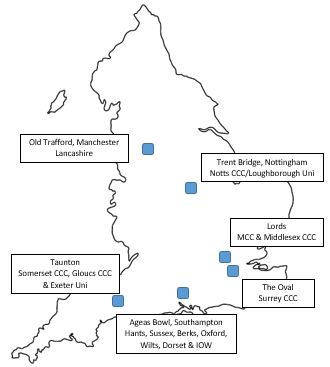
How the WCSL Map might look?
But from the flurry of recent press releases it does seem as though some interesting bids have been submitted, with an interesting geographical spread.

Hampshire CCC are fronting a bid for a south coast franchise, based at the Ageas Bowl in Southampton, with the "support" of Sussex, Berkshire, Oxfordshire, Wiltshire, Dorset and the Isle of Wight. Quite what "support" means is not made clear.

Somerset CCC, Gloucestershire CCC and Exeter University have combined for a possible south west franchise, based around the university's training facilities and the county grounds at Taunton and Bristol.

In the north west Lancashire have confirmed their interest in being a WCSL franchisee, with the support of the Cheshire CB. Lancashire can of course boast the excellent training and playing facilities they have at their disposal at Old Trafford in Manchester.

It also looks like London could have two rival franchises based at Lords and the Oval. The MCC and Middlesex are believed to be getting together to try and get a franchise based at the Home of Cricket, and Surrey CCC stated back in July that they would be submitting a bid, with, you would guess, the Oval as hub of their franchise.

So what of the Midlands? All quiet so far, but there has been a great deal of interest from Loughborough University, where of course the National Cricket Performance Centre has been established. The problem Loughborough has is that they do not have a ground that could host televised matches with crowds. The nearest first-class men's and women's county is Nottinghamshire, so it would be no surprise if they submitted some kind of joint bid, perhaps with the support of one or more of Warwickshire, Staffordshire and even Worcestershire.

As for the north east Yorkshire, last year's Division One county champions, are the closest and biggest women's county, but have yet to commit to any bid. And in the south east it does not look as though any bid will be forthcoming from Kent or Essex, perhaps on the basis that they know they could not compete with the resources available to the London-based franchises.

For now it is all speculation, but once the bid winners are announced the next headache will be how the England and England Academy players are allocated to the various franchises. No-one has quite explained how this will be done, only that the hope is that the teams will all share the England resources equally to ensure a tight and entertaining competition.

No wonder Clare Connor is having sleepless nights.

MD
12/XI/15

Tuesday, 18 August 2015

No way back for shattered England

Losing the Ashes Test means that England are now 2-8 down in the Ashes Series with 6 points up for grabs from the remaining T20s. They would have to win all three of the T20s against the current T20 World Champions to retain the Ashes. They will not do so. This is a team that looks devoid of confidence in their own abilities. Almost without exception they are batting like rabbits caught in the headlights of an oncoming truck. They appear to be so terrified of making a mistake that they are literally paralysed into inaction.

It is true to say that in the last Ashes Series played in England in 2013, England did win all three of the T20s they played against the Aussies, and England are unbeaten at "Fortress Chelmsford" where they are playing the first T20 on Wednesday week (26th August). But that is all history and England have spent the past five years looking back at past glories as an indicator of future performance. It has not panned out.

Those of us who have watched England closely (and the England players in their county colours) over the last few years have frequently lamented the lack of depth to the England batting line-up. Charlotte Edwards and, to a lesser extent, Sarah Taylor, have been the props holding the batting up. England have doggedly stuck to the same players time after time after time. There have been fleeting glances of form - Lauren Winfield's 74 against the South Africans last summer at Edgbaston; Nat Sciver's 65* against the Kiwis at Lincoln in February, but there have been far more failures than successes.

Last year's Test against India should have rung some alarm bells. 12 of the 20 England wickets that fell were to lbw appeals, on a slow, low track that offered little or nothing to the seamers or spinners. The problem was players playing across the line. Professional England, as they had become, were bowled out for 99 and 202 against a team of amateurs and lost by six wickets. It was not a blip, but it was indicative of the fragility of England's batting.

In New Zealand the England middle-order simply failed to turn up for the first three ODI games, which meant England lost the ICC WC series 1-2. They are currently languishing in fourth place in the ICC WC table, seven points behind leaders Australia, having won just four out of the nine games they have played.

England have adopted a head in the sand attitude. England's demise in the Test was all too predictable and they have no-one to turn to to try and get them out of the hole they are in, bar the 18 contracted players on whom they have concentrated all their efforts over the past two years. There are no T20 batting superstars waiting in the wings, so the same batting line-up is likely to be asked to do what they can. With confidence at rock bottom they are likely to get blown away.

Short-term there is little that England can do, bar try and inspire, enthuse and re-invigorate the current crop of players. That inspiration and leadership needs to come from the top.

Longer-term England need to take a hard look at the current contract system. The 18 players contracts are due to be reviewed in September and new contracts awarded in October. By that time the same 18 players will already have been contracted for 18 months. Should the cash be shared more fairly amongst those who have potential? Everyone below the 18 contracted players are unpaid amateurs. Even those additional players named in last year's ECB Winter Training Squad - Jodie Dibble, Beth Langston, Sonia Odedra, and Fran Wilson. For the past 9 months they have been doing exactly the same as the 18 paid players, for nothing. None of them were offered a car by KIA. Also what will happen to contracted players whose contracts may be terminated? There is no cushion of going back into county cricket and earning a reasonable salary while trying to get your place back. Chances are they will be lost to cricket for good.

England also need to look beyond the Loughborough Bubble. At the present time it seems like it is almost the only route for progression into the England set-up. The other MCCU universities do little or nothing to enhance women cricket players. In fact the second best university for women cricketers is non-MCCU Exeter University - current holders of the BUCs Indoor Title and runners-up to Loughborough for the last two years in the BUCS Final at Lords. This year Exeter just had to contend with seven full internationals, two Academy players and one U19 EWDP player in the Loughborough team that defeated them.

Clare Connor herself espoused the importance of cricket players getting an education and qualifications as well as playing the game. Even if girls reach the top the salaries are not high. Life at the top can be precarious, subject to form, favour and fitness. And even the longest careers are likely to only stretch into the 30s. That leaves a long time after cricket. Getting that education at Loughborough should not be a prerequisite to success on the cricket field. The ECB need to expand their horizons.

Alongside, or in conjunction with, the new WCSL (Women's Cricket Super League), the ECB needs to expand the centres of excellence available for women cricketers, so that young players can continue their education away from Loughborough if they chose and avoid excessive travel time to train regularly. It will also allow other coaches to feed into the development of players.

I am a fan of the concept of the WCSL, and what it is trying to achieve. There are simply not enough good players to go around the current 38 county system. But it is going to be difficult to implement if the non-contracted players are not paid. The ECB have no objection to the franchises paying their players, but they are not going to fund it, and what happens if one franchise does and another does not?

In the short-term it seems odd that none of the England batsmen involved in the Test were released to their counties this weekend to play in the final round of the NatWest County T20 competition. Surely it would have been ideal preparation? Instead they will have a couple of practice games this week against young male opponents. Australia meanwhile are in Ireland playing three T20Is against the Ireland Women's team that has beaten both Sussex and Yorkshire in Division One T20 games in the past couple of weeks.

England tour South Africa in February for more ICC WC games and in March the T20 World Cup is being staged in India. The WCSL will not come quickly enough to have any effect on England's performances in these tournaments. Indeed it will not really be up and running properly before England host the World Cup in 2017. The next few years could be tough for England on the international circuit.

MD
18/VIII/15

Monday, 10 August 2015

Women's Cricket Super League is a step closer

The ECB have today announced that the Women’s Cricket Super League has attracted strong interest at the first stage of the host award process.

The England and Wales Cricket Board (ECB) has received 28 ‘expressions of interest’ in the opening stage of the process to determine the six team hosts for the inaugural Women’s Cricket Super League.

The opportunity to host a team was outlined last month and laid open to any forward thinking cricket-minded organisation, both from within and outside of the traditional cricket landscape. 

The range of ‘expressions of interest’ submitted feature:

·         All 18 First Class counties, on their own or in collaboration with other local partners
·         A broad geographical spread across England and Wales
·         A diverse variety of organisations, including innovative partnership working between cricket bodies, educational institutions and local authorities

The Women’s Cricket Super League will start in the summer of 2016 and during its first season will be comprised solely of T20 cricket.  From 2017 onwards the structure will develop to both T20 and 50-over formats.

Speaking about the strong opening response to the award process, ECB Director of England Women’s Cricket, Clare Connor, said:

“The level of interest shown in becoming a Women’s Cricket Super League team host through the initial ‘expression of interest’ process has been remarkable and reflects a strong, national appetite for a new and dynamic competition. 

“Despite levels of participation in sport and exercise being a concern across the UK, participation in women’s and girls’ cricket has seen pleasing growth in recent years.  We are really excited about the innovative opportunity that the Women’s Cricket Super League gives us to reach new participants and attract new fans to the game, and we are determined to make the most of this opportunity. 

“We now look forward to exploring each different approach, finding out who the six eventual hosts will be, and then working with them to create the high performance environments which are best placed to secure England’s success on the international stage for years to come.”

ECB Women’s Cricket Super League General Manager, Jo Kirk, who was appointed in July, added:
“The variety of the organisations involved and the extent of collaborative work outlined within the ‘expressions of interest’ received is really exciting.  We are now looking forward to seeing how each of the 28 plans develop through the invitation-to-tender window.

“Internal ECB assessments of responses and interviews of prospective hosts will take place during October and November.  It is anticipated that the final confirmation of the hosts for the six Women’s Cricket Super League teams will be announced during December 2015.”   

MD
10/VIII/15

Tuesday, 14 July 2015

MCC want to be a Super League Host

The MCC World Cricket Committee have just issued a statement which covers many issues, but the most important to women's cricket in England is that the MCC are working with Middlesex to become one of the WCSL hosts.

The statement reads as follows:-

"MCC to express an interest in becoming an ECB Women’s Super League Host
The World Cricket committee received an update on the recently announced ECB Women’s Super League, and discussed the growth of the women’s game in general.
The committee also heard about plans for the Women’s Big Bash in Australia, and was pleased to learn that MCC has expressed an interest in becoming an ECB Women’s Super League co-host along with Middlesex CCC.
Whilst specific details of the ECB competition are emerging, MCC will work in conjunction with Middlesex with the aim of hosting a team in the women’s competition, and sees it as an exciting opportunity for MCC to support the women’s game as it develops and grows."

MD
14/VII/15

Thursday, 18 June 2015

Women's Cricket Super League to start in 2016

The ECB have today announced that a new Women's Cricket Super League will start in 2016. Amidst a blaze of camera crews and familiar cricket faces from Sky, TMS and the like, Clare Conner, the Head of Women's Cricket in England, sat patiently outlining what she described as the "most significant development in women's cricket for a very long time". Her enthusiasm for the project was obvious and the amount of media attention almost unprecedented in the women's game. It was exciting to be part of it, and one can only hope that the product that is produced at the end of the day is just as exciting.

The headlines are that there will be six Women's Cricket Super League teams, with the ECB investing £3M in the project over the next four years. In 2016 the six teams will compete only for a T20 prize, which will include some money, both for the players and the organisation that is running the team - quaintly referred to as "the host". In 2017 this will be extended to a new WCSL 50 over competition as well. Quite who those "hosts" will be is not clear yet, as the ECB are asking for "Expressions of Interest" from organisations that want to be involved in the project - these could be existing counties, universities, sporting organisations such as the MCC or indeed organisations involved in any sport. The ECB is basically open to offers. Hosts will need to prove a business case to the ECB to be awarded one of the six team franchises (although pointedly this was not a word that was used during the Press Conference) and they will be tied in for four years. How do you make your case? Well you will need to tick the ECB's checklist of criteria which relate to expertise, standards, coaching model, engagement with the community, growth forecasts and general business development. Franchises will hopefully be awarded by the end of 2015.

If you are lucky enough to be awarded a hosting position, then in Year One the ECB will give you half of what they estimate it will cost to run your team for the year. The other half will apparently be value in kind, by way of facilities, expertise, existing coaching staff etc. The reality is that the host will probably have to stump up some of their own cash, or cash that they have derived from commercial sponsors. Quite what the cost of running a team is deemed to be seemed to be a moot point, but it sounded as though the ECB would contribute substantially less than £100,000 in the first year to each team, but that this would grow in subsequent years.

Unlike the Aussie state system none of this money is earmarked for salaries. The ECB would like the players (outside of the 18 contracted players) to be paid, but they are not insisting that this is a part of the host's model. It will be a matter for the host's themselves. As for ECB contracted players they cannot apparently be paid additional sums, although how long this would be sustainable seems doubtful. Are they really going to play more competitive cricket for no more money? How will hosts attract the best contracted players to come and play for them, rather than the team down the road? And what of those just outside the 18? If you can offer them even a small amount of cash to play, then surely your team is going to be more appealing? Failing to dictate, and initially pay for, player salaries may save the ECB cash, but it is a black hole of future problems. Match fees, player expenses and "overseas players contributions" are apparently catered for in the funds allocated to hosts by the ECB.

Those problems, and possibly many others, will land on the desk of the shortly to-be-appointed ECB Women's Cricket Super League General Manager. He or she will be busy over the next few months.

The first competition will be the WCSL T20 probably for 16 to 18 days in August 2016. The year after the 50 over competition will start, possibly with just five games per team, but more likely ten. It will be a question of scheduling as England are also hosting the Women's 50 over World Cup, plus there will still be the WCSL T20 competition and county cricket fixtures. Asked if players would be expected to play in both WCSL fixtures and county fixtures, Connor suggested that all but the top 25 players in the country would probably end up playing in both.

So far from seeing the WCSL as the demise of county cricket, Connor confirmed that the ECB would continue to invest as much, if not more in the county game, and also would be looking to reinvest in club cricket, described by Connor as "a bit of an abandoned child at the moment". There is a realisation that these form the base of the pyramid that leads to elite players at the very top. But interestingly county cricket will not involve Scotland, Ireland or the Netherlands after 2017. Players from these teams would be regarded as overseas players for WCSL purposes, and WCSL teams will be limited to just two overseas players.

So will you be watching the WCSL on your television next year? Naturally the ECB would love this to be the case, but they are currently tied in to a deal with Sky until 2019. Does the WCSL fall under this agreement? That may be for the lawyers to decide. Free-to-air coverage would be ideal, and would make hosting a team even more appealing. If the games are going to be on tv then hosts would find it infinitely easier to encourage team sponsors onboard. At the moment television coverage looks doubtful, but if the Women's Big Bash in Australia proves to be a ratings success on Aussie television then this might speed matters along.

Is this good news for English cricket? Undoubtedly. There is a lot of flesh to be put on the bones and plenty of wrinkles that will need to ironed out over the next few months and years. But this is a huge step towards "professional women's cricket" and a bigger pool of better players for England to choose from in years to come. Clare Connor and the ECB are to be congratulated on a job well done so far. Hopefully the WCSL will be the catalyst to more good women's cricket, more interest from commercial sponsors and television executives, and more interest from the general public. Exciting times indeed!

MD
18/VI/15

Tuesday, 17 March 2015

New Women's Cricket Super League

There has been a lot of speculation about what might or might not come out of the current review of the structure of women's cricket in England. It seems to be accepted that the current county structure is not "fit for purpose", and that there needs to be something with fewer teams, playing a better standard of cricket, between international cricket and the current county set-up. For want of a better phrase I have called this a "Super League". It also seems to be accepted that this level of cricket needs to be better financed and the players need to be paid for their commitment to it, as they are in state cricket in Australia.

Let's assume, just for a moment, that professional "franchise" cricket is going to be introduced in 2016, or sometime soon after, both for T20 and 50 over cricket. How is this going to be structured and how is it going to work?

The more I think about it the more complicated it gets. It is not just a question of throwing money at a few of the current counties and asking them to run the six or seven new franchise teams, who are going to play in the new Super League. Women's county cricket needs more than that. I hope the ECB will see that and perhaps look to appoint someone to oversee the whole project and make sure that the money that is going to be invested actually produces the results that the ECB are craving - better quality cricket, better players for England and a better product for paying spectators and television companies. Hopefully these are the aims, aren't they?

Currently women's county cricket is run by a handful of overworked and unpaid volunteers. All county cricket boards receive some funding direct from the ECB for women's cricket. But any money that is paid is paid to the county cricket board, who may, or may not, make it available to their women's cricket section. My understanding is that the ECB do pay towards some expenses - pitch hire, accommodation, staging of tournaments, etc. The rest of the expenditure needs to be covered by the county themselves - sponsors, fund-raising and players paying for their own kit, travel etc. The current annual budget for the running of a women's county team is probably less than £10,000.

If professional franchises are going to be introduced they need to be professionally run from the top down - ie they need a proper management structure with competent business/marketing/cricketing people at the helm. People who know women's cricket. It is NOT the same product as men's cricket, and to leave it in the hands of men's county executives and committees would be wrong. Women's franchises need proper coaches giving proper coaching and properly managing players and the games they play in. Women's cricket at the Super League level needs to be taken seriously and the women that play it need to take it seriously too. Izzy Westbury, in an article for the current issue of All Out Cricket, wrote about training in Australia - "Every training session and every match is tackled in the same way - with the same intensity, regardless of whether you are turning out for Australia, your state or your club". This does not happen in county cricket here in England. This attitude has to change and that will not happen if the current structure is not changed too.

Then, of course, the players need to be paid. In Australia each state is given $100,000 for the season (£50,000), from which they have to pay each of their players between $2,500 - $7,500, which would account for about half that sum. In addition CA also cover travel and accommodation expenses for the states. The state cricket associations still have to pay for balls, kit, pitch hire, umpires, scorers, training facilities etc.

The only players paid anything in England at the moment are the 18 contracted England players. There are apparently three different types of contract - tiers 1, 2 and 3 - but no-one knows how much any of the tiers are worth or who is on what tier. Speculation suggests £50,000 for tier 1 and about £20,000 for tier 3. The level below full-England contracts currently includes four players who were in the Winter training squad and 12 players in the England Academy. You would guess that for players at this level their "Super League" contracts might be worth at least £2,000 pa. It does not make them professional, or even semi-professional, but it does help with kit, travelling, physios etc.

So how should the ECB structure the new Super League? I have previously suggested seven regional teams - South East, South, South West, South Midlands, North Midlands, North West and North East, with England players and England Academy players evenly spread between the new franchises - an extended Super 4s structure if you like. The problem will be where do you base these teams for training and games? Will the ECB be able to convince the counties to allow them to use say, Chelmsford, Hove, Taunton, New Road, Grace Road, Old Trafford and Scarborough?

The temptation will be to award "franchises" to current "successful" county set-ups, but I am not sure that would produce the best results. I would much prefer that the ECB invited organisations to tender for the right to run an ECB franchise. Those who think they can do it would then have to say how they would run a new franchised team - management structure; marketing; grounds; costs; sponsorship. The current county set-ups will be in prime position to win these, but there are others who might want to throw their hat into the ring (universities for example), or perhaps join with existing counties to bring a new dynamic to the women's game. I also think it is important that the Super League teams are given their own, new identity - not Essex Eagles or Lancashire Lionesses, but Tesco Tigers, HSBC Hurricanes, B3 Devils etc.

And what then becomes of County Cricket, below the Super League? This MUST still be funded by the ECB to at least the current level of funding. It should continue in its current format, providing an opportunity for young and old county players to play at a level above club level. It should be seen as an important feeder for the Super League.

I doubt much more will be heard from the ECB until the end of this summer's Ashes series. But if England want to remain at the forefront of women's cricket then changes need to be made pretty soon, particularly with the Aussies getting the Women's Big Bash underway later this year. England Women cannot afford to be left behind as the England Men have been.

MD
17/III/15